HRZZ Research Project
Probing beyond the Standard Model scalar sector at the LHC
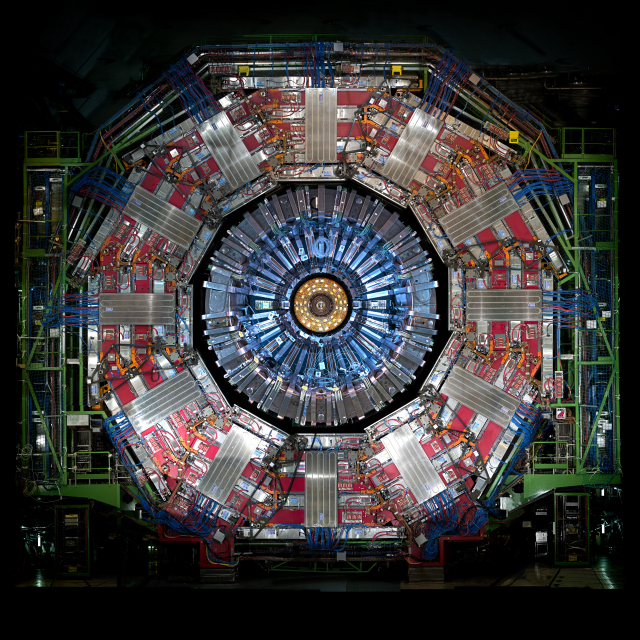
Searching for new scalar particles and dark matter candidates with the CMS experiment at CERN.
Research Focus
The PROBE-S project addresses key open questions in particle physics through three interconnected pillars.
Triple Higgs Production
Searching for signatures of extended scalar sectors through the elusive HHH final state, unattainable via the Standard Model alone at the LHC.
Detector Performance
Precision studies and calibration of the CMS silicon pixel detector to ensure high-quality data collection throughout Run 3.
Beyond the Standard Model
Exploring new scalar particles and dark matter candidates through joint experimental–theoretical phenomenology.
About the Project
PROBE-S aims to probe the scalar sector of the Standard Model and search for new physics at the energy frontier.
Our current understanding of the fundamental building blocks of matter and their interactions is encapsulated by the Standard Model (SM), which, despite its successes, has notable shortcomings that suggest the need for a more fundamental theory. Proposed models of physics Beyond the Standard Model (BSM) predict new phenomena potentially observable at the Large Hadron Collider (LHC) at CERN, our prime tool for exploring BSM physics.
The LHC began its third running period (Run 3) in 2022, operating at higher collision energies and aimed at tripling data collected from previous runs by the end of Run 3 in mid-2026. While the Higgs boson discovery in 2012 was a landmark achievement, searches for BSM physics have yielded limited results, though some deviations from SM have emerged.
With the LHC nearing its ultimate energy capabilities, we focus on two strategies: exploring uncharted territories and accumulating data to verify observed anomalies. The Higgs boson, central to electroweak symmetry breaking, opens a new avenue for BSM searches, as BSM physics is likely to couple with it. Moreover, it may not be unique in nature as there is no inherent principle precluding the existence of additional scalar particles.
This project aims to investigate new scalar particles as predicted in extended scalar sector models of the SM, specifically targeting a rather spectacular final state with three Higgs bosons that has garnered recent interest. An observation of this state, unattainable at the LHC via the SM alone, would provide compelling evidence for BSM physics. Additionally, we will conduct phenomenological studies of extensions of the scalar sector that provide dark matter candidates. Ensuring high-quality data collection is crucial for this project, which includes monitoring and calibration activities to maintain the pixel detector's performance in the CMS experiment. A discovery stemming from this research could profoundly reshape our understanding of fundamental physics.
Project Details
Research Objectives
The project is organized around three interconnected objectives that span experimental data analysis, detector operations, and theoretical phenomenology.
Research Team
The PROBE-S team brings together experimental and theoretical expertise from the Ruđer Bošković Institute.
Get in Touch
For inquiries about the PROBE-S project, collaboration opportunities, or outreach activities, please contact the Principal Investigator.